- College Predictor 2026
- About CUET (UG)
- Courses
- Blogs
- Home
- Logout
- Login
- Language: Eng | हिंदी
CUET 2027 Subject Combination: The Right Choice for DU, BHU, JMI, AU & AMU
Your CUET 2027 subject combination decides which universities you are even allowed to apply to — long before your score decides which one you get into. And every year, thousands of students discover this in July, when the portal tells them they are "not eligible" for the course they spent a year preparing for.
There is a myth doing the rounds that needs to die: study anything, appear for CUET, selection ho jayega.
It does not work like that.
Two students start preparing in the same week. One knows exactly which three or four universities she is targeting, which programme she wants, and precisely which subjects that programme counts. The other has picked up five subjects because someone told her "one language + GAT + three domains covers every university in India," and she is trusting the rest to luck.
The first student usually gets in on her first attempt. The second is often the dropper — sometimes the double dropper — sitting in the same chair a year later, still not sure what went wrong.
The difference is rarely intelligence. It is almost always the subject combination.
Watch the full session: CUET 2027 subject combination explained
SSR Sir walks through the important subject combinations for DU, BHU, Jamia, Allahabad University and AMU — including the mistakes that cost students a year. The written breakdown continues below.
First, the exam has changed — and it changes your combination strategy
Before we get to universities, one structural fact most 2027 aspirants have not absorbed.
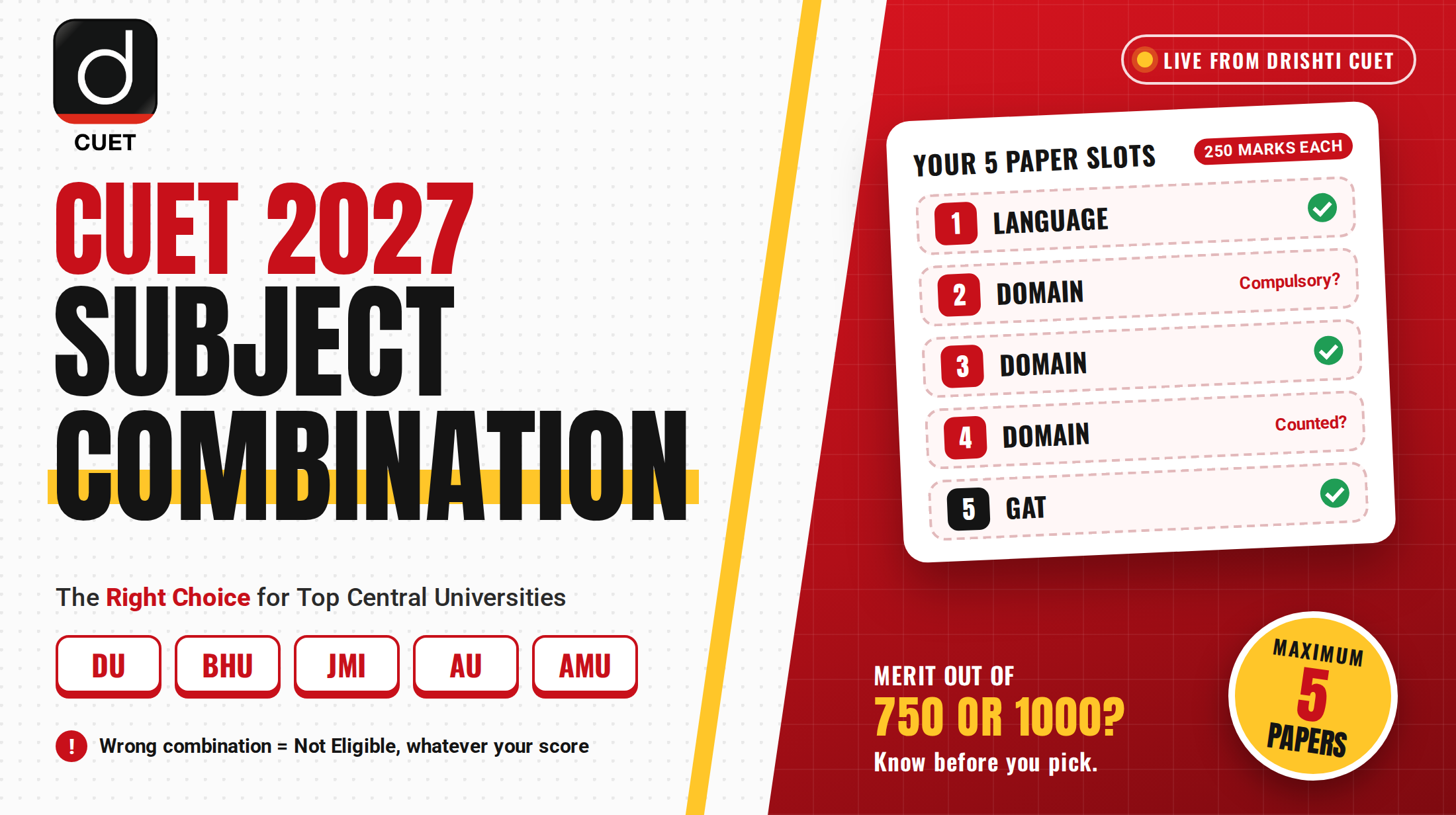
For CUET UG 2026, NTA cut the subject list from 63 down to 37 papers — 13 languages, 23 domain subjects and the General Aptitude Test — and reduced the maximum number of papers a candidate may choose from six to five, including languages and GAT. Every paper is 50 compulsory MCQs in 60 minutes, worth 250 marks, marked +5 for a correct answer and −1 for a wrong one, entirely in computer-based mode. There are no optional questions any more.
Five subjects were dropped from DU's own domain list — Legal Studies, Engineering Graphics, Teacher Training, Entrepreneurship, and Knowledge Tradition and Practices of India — with GAT scores used instead for the affected programmes.
Three consequences follow immediately:
- You have five slots. That is the whole budget. The old "take everything, stay eligible everywhere" plan is no longer even available in its original form.
- Every paper is worth 250 marks. This is the arithmetic behind the 750-vs-1000 question below. Three counted papers = 750. Four = 1000. Five = 1250.
- Negative marking with no optional questions means partial preparation is now punished. Carrying a subject you have half-prepared does not just fail to help — it can actively pull your score down.
Assume this structure continues into 2027 unless NTA says otherwise, and check the official bulletin when it lands. We track the confirmed pattern, syllabus and eligibility for the next cycle in our CUET UG 2027 guide, updated as NTA notifies changes.
Why the wrong subject combination quietly costs you a year
Every extra subject you carry is not one extra subject. It is:
- one more NCERT to finish
- one more set of PYQs to solve
- one more mock series to attempt, week after week
- two to three hours a day, pulled away from the papers that actually count
And here is the trap. That extra subject is very often your weakest one. So you are not just spending time on it — you are getting demotivated by it, month after month, for an entire year. One bad subject can poison a whole preparation cycle, not just one score.
Meanwhile, the marks may not even be counted by the university you are targeting.
That is the real cost. Not the hours. The confidence.
The 750 vs 1000 rule: how your CUET merit is actually built
This is the single most useful thing on this page, and most students find out about it far too late.
Universities do not count all your CUET papers for every course. Depending on the programme, they count three papers or four — which is why seniors talk about merit "out of 750" or "out of 1000."
- Out of 750 → three counted papers × 250
- Out of 1000 → four counted papers × 250
The consequence is direct. In a course where merit is out of 750, a fourth subject you slogged over adds nothing to your rank. In a course where merit is out of 1000, your language paper is not a formality — it is a full quarter of your merit.
Watch this in the DU table below. For BSc (Hons) Physics and Chemistry, the counted papers are Physics, Chemistry and Mathematics — merit out of 750. For the BSc Mathematics group, a language paper is counted and merit runs out of 1000. Same university, same exam, completely different strategy.
Two DU rules that decide eligibility before merit
DU adds two conditions that catch students out every single year:
You must appear in CUET in the subjects you studied in Class 12. DU's CSAS brochure is explicit about this, and it means your Class 12 stream has already narrowed your legitimate combinations.
Subject mapping is your responsibility, not the university's. At the CSAS registration stage you map your Class 12 subjects to the CUET papers you sat. DU uses NTA's normalised subject scores, auto-calculates your programme-specific merit for every course you are eligible for, and states plainly that providing correct subject mapping is the candidate's own responsibility. A mapping error is not a technicality — it silently removes courses from your dashboard.
DU organises the papers into List A (languages) and List B (domain subjects), and eligibility for each programme is written in terms of those lists. For 2026 the university kept both lists unchanged from the previous year: 14 entries in List A and 22 in List B. Read your target programme's requirement in that language, because that is how DU writes it.
Delhi University: CUET subject combinations (course-wise)
|
DU Programme |
Required subject combination |
Merit out of |
|
BSc (Hons) Physics / Chemistry |
Physics + Chemistry + Mathematics / Applied Mathematics |
750 |
|
BSc (Hons) Bio group |
Physics + Chemistry + Biology |
750 |
|
BSc (Hons) Mathematics / Statistics / Computer Science / Mathematical Sciences |
Combination I: one language (List A) + Maths/Applied Maths + any two List B subjects. Combination II: two languages (List A) + Maths/Applied Maths + one List B subject |
1000 |
|
B.Com (Hons) |
Language + Mathematics or Accountancy + any two domains |
1000 |
|
B.Com (Programme) — option A |
Language + three domains |
1000 |
|
B.Com (Programme) — option B |
Language + GAT + one domain |
750 |
|
BA (Hons) Humanities — option A |
Language + three domains |
1000 |
|
BA (Hons) Humanities — option B |
Two languages + two domains |
1000 |
|
BA (Programme) |
Language + three domains or two languages + two domains (1000) or language + GAT + one domain (750) |
1000 / 750 |
|
BA (Hons) Economics |
Language + Mathematics compulsory + any two subjects, at least one from List B |
1000 |
|
BBA / BMS / BA (Hons) Business Economics |
Language + GAT + Mathematics + one domain |
1000 |
|
B.Tech |
Language + GAT + Mathematics |
750 |
|
BA (Hons) Journalism |
English compulsory + any three subjects, or English + GAT |
— |
|
Five-Year Integrated Journalism |
Any language + Mass Media & Communication + GAT, or any language + GAT |
— |
Three lines there end a lot of plans every year:
BA (Hons) Economics at DU needs Mathematics. Compulsorily. If Economics Honours is your target and you dropped Maths from your CUET plan, you are not eligible — whatever your total.
BA (Hons) Journalism at DU needs English specifically, not "any language." A brilliant Hindi score does not substitute.
BSc Bio group is a 750-merit course with some of the highest closing scores in the university. Three counted papers, very little room for one weak paper.
Where the top of the scale actually sits
For scale: SRCC's BA (Hons) Economics General-category closing score finished around 909–910 out of 1000 in the 2025 cycle, and reported 2026 figures for the General category sat in the high 880s to high 890s depending on the round. Aggregator sites disagree with each other on the exact number, and DU publishes round-wise closing scores itself — so treat any figure you see quoted, including this one, as a rough benchmark and confirm it on the CSAS portal.
For a full read on how to interpret these numbers rather than fear them, see our companion piece on what CUET score you actually need for DU.
BHU: CUET subject combinations
A structural point first. BHU is a UP university, and UP universities generally consider only Hindi or English in the language section. If you were planning to lean on a regional language as your strong paper, confirm this before you build a year of preparation on it.
|
BHU Programme |
Required subject combination |
|
BA LLB |
Hindi or English + GAT compulsory |
|
BSc (Hons) Agriculture |
PCM or PCB or Agriculture / Biochemistry |
|
BSc (Hons) — Maths group (Maths, Statistics, Computer Science, Physics, Chemistry, Geography, Earth Science) |
Physics + Chemistry + Mathematics |
|
BSc (Hons) — Bio group |
Physics + Chemistry + Biology |
|
BSc — Botany, Chemistry, Geology, Home Science, Geography, Earth Science |
Physics + Chemistry + Biology |
|
B.Com / B.Com (Hons) Financial Management / Marketing Management |
Accountancy + Business Studies + GAT |
|
Dairy Technology & Food Technology (B.Tech branches) |
Physics + Chemistry + Mathematics |
|
Vocational Studies, Fashion Designing, Apparel Designing |
Language + GAT |
|
BA (Hons) — Economics, History, Political Science, Psychology, and language courses (Urdu, English, Japanese, Chinese, German, French) |
Hindi or English + GAT |
|
BFA — Painting, Textile Design, Plastic Art |
BHU's own subject/practical test + CUET UG score |
|
Performing Arts |
Performing Arts paper + BHU practical examination + CUET UG score |
BFA and Performing Arts deserve separate planning. Merit there is not CUET alone — BHU conducts its own practical examination and both scores combine. If that is your path, your portfolio and practical timeline matter as much as your mock schedule.
Jamia Millia Islamia (JMI): CUET subject combinations
Jamia is refreshingly simple — several Honours programmes ask for the single relevant paper.
|
JMI Programme |
Required subject |
|
BSc (Hons) Physics |
Physics |
|
BSc (Hons) Chemistry |
Chemistry |
|
BSc (Hons) Applied Mathematics |
Mathematics |
|
BA (Hons) Hindi |
Hindi |
|
BA (Hons) foreign languages — French, Spanish, Turkish, Korean, Persian |
GAT |
If a single-subject Honours at Jamia is a serious backup for you, that reorders your priorities immediately: one domain paper prepared deeply does more for you than three prepared thinly.
Allahabad University: CUET subject combinations
Allahabad's structure is more awkward than the rest, because a language and GAT are both compulsory across these courses — leaving you a single domain slot.
|
Allahabad University Programme |
Required subject combination |
|
BSc — Maths group |
Hindi or English + GAT compulsory + any one of: Physics, Chemistry, Maths, Computer Science, IT, Geography, Geology, Environmental Science |
|
BSc — Bio group |
Hindi or English + GAT compulsory + any one of: Biology, Biological Studies, Biotechnology, Physics, Chemistry, Anthropology, Environmental Science |
|
BA LLB |
Hindi or English + GAT compulsory |
|
BA LLB (Hons) |
Hindi or English + GAT + any one domain subject |
|
B.Com (Hons) |
Hindi or English + GAT + any one of: Accountancy, Physics, Chemistry, Maths, Computer Science, Biological Science, Environmental Science |
If Allahabad is on your list, GAT is not a filler paper. Students routinely plan to "manage GAT on exam day," then discover it carrying a third of their merit.
AMU (Aligarh Muslim University): CUET subject combinations
|
AMU Programme |
Required subjects |
|
BSc (Hons) Community Science |
English, Physics, Chemistry, Biology or Home Science |
|
BSc (Hons) Statistics |
English, Physics, Chemistry, Biology or Mathematics |
|
BSc (Hons) Geography |
English, Physics, Chemistry, Biology and Mathematics |
A real combination that worked (and why)
A student from Punjab cleared BA Economics. His combination looked unusual on paper: Punjabi as his language, plus Mathematics, Political Science and History.
Ask why it worked and the logic is almost boring:
- Punjabi was a genuine strength — a regional language he had grown up reading and writing. Near-free marks.
- Political Science and History were papers where his scores came without heavy lifting.
- That left Mathematics as the only paper he actually had to grind. One subject. All year. Full focus.
Compare that with a student who takes the same target and adds Physics, Chemistry and Biology to "keep options open." Four hard papers, four mock series, no depth anywhere — and now, with a five-paper ceiling, no room left for the language that would have carried him.
The lesson is not "take Punjabi." It is: build your combination on the papers where you are already strong, then put everything you have into the one or two your target course makes compulsory.
CUET 2027: the process, and what is not yet known
NTA has not released the CUET UG 2027 information bulletin, so every date circulating online is an estimate drawn from previous cycles. Based on recent years, registration is expected to open around January 2027 with the exam in the May–June window, in CBT mode.
|
Stage |
Expected timing (not notified) |
|
Information bulletin and registration opens |
January 2027 |
|
Correction window |
Shortly after the registration deadline |
|
CUET UG 2027 exam |
May–June 2027 |
|
Result and scorecard |
After the exam window closes |
|
University counselling — separate form for each university |
After result |
|
Seat allocation rounds, upgradation, spot rounds |
Through the admission season |
Two warnings worth more than the table:
Registration windows are short. In recent cycles they have run roughly four to five weeks. Missing it costs a full year, and NTA has historically announced dates at relatively short notice — so check cuet.nta.nic.in weekly from January onwards rather than waiting for a forward.
Counselling is not centralised. DU, BHU, Jamia and Allahabad each run their own process, each needing its own registration. A strong CUET score with a missed counselling form produces the same outcome as a weak score.
For the full expected timeline, eligibility criteria, syllabus and exam pattern in one place, read our detailed guide: CUET UG 2027 — exam date, registration, eligibility and syllabus.
How to lock your CUET 2027 combination in five steps
- Fix your programme first, not your subjects. BA Economics? B.Com (Hons)? BSc Mathematics? Everything downstream depends on this one decision.
- Shortlist four or five target colleges. Not one — one is a gamble. Not fifteen — chase fifty doors and you will be left standing outside all of them.
- Open each university's official admission page and read the eligibility yourself. Not a YouTube screenshot, not a Telegram forward, not this article. Combinations change. The official page is the only thing that counts.
- Write "750" or "1000" next to each college name. This single note tells you whether your language paper is decoration or a quarter of your merit.
- Cut every paper that appears on none of your lists. Hardest step, highest return — and with a five-paper ceiling, no longer optional.
If you are in Class 12 right now
Your problem is not information. It is collision. Board syllabus, board practicals, school tests and CUET preparation are all competing for the same evenings, and most students respond by running two separate projects that both suffer.
The subject-combination decision is where this either gets solved or gets worse. Choose a combination that overlaps heavily with the subjects you are already sitting boards in, and one plan serves both exams. Choose a scattered combination and you have built yourself two syllabi.
Our FUSION Batch for CUET 2027 is designed for exactly this cohort — Class 12 students who need board and CUET preparation running as one integrated plan rather than two competing ones. You can see how it is structured at drishtilearningapp.com/cuet/courses.
If you are preparing for CUET 2027 again
Droppers have one enormous advantage over first-timers, and most of them waste it: you have a scorecard.
Before you touch a book, put your CUET 2026 subject-wise scores next to your target programme's counted papers. Then answer honestly: was your merit dragged down by one specific paper, or was it spread thin across four? Did you lose marks to syllabus gaps, or to negative marking on guesses? And — the question nobody wants to ask — was the paper that sank you even a counted paper for your target course?
Rebuilding your combination on that evidence is worth more than any generic study plan. What a repeat year usually lacks is not information but structure: the timetable, testing rhythm and accountability that school used to supply and a drop year does not. Our CAMPUS Batch for CUET 2027 is built around that problem for droppers and repeaters — details at drishtilearningapp.com/cuet/courses.
Mistakes to avoid
- Taking the maximum number of papers "for safety." It sounds like insurance. It behaves like a tax on your best papers — and with negative marking and no optional questions, a half-prepared paper can cost you marks rather than add them.
- Assuming any language will do. DU Journalism wants English. BHU generally wants Hindi or English.
- Treating GAT as a bonus. For Allahabad and several BHU courses it is compulsory and heavily weighted.
- Appearing in CUET papers you did not study in Class 12 when your target is DU, which requires the two to match.
- Rushing subject mapping at CSAS. DU auto-calculates your merit from what you map, and states that correct mapping is your responsibility.
- Dropping Maths and then targeting Economics or Commerce Honours. Non-negotiable at DU.
- Preparing for the exam and ignoring counselling. Separate forms, separate deadlines, separate universities.
- Copying a senior's combination. Their strengths and their target list are not yours.
Frequently asked questions
1. What is the best subject combination for CUET 2027? There is no single best combination. The right one satisfies your target course's eligibility while sitting on your strongest papers. Fix the programme and the college list first — the subjects follow from those.
2. How many subjects can I choose in CUET? For CUET UG 2026 the maximum was five papers in total, including languages and the General Aptitude Test, reduced from six in earlier cycles. Expect the same ceiling for 2027 unless NTA notifies a change.
3. Why is CUET merit sometimes out of 750 and sometimes 1000? Each CUET paper carries 250 marks. Universities count either three or four papers depending on the programme, so merit comes to 750 or 1000 accordingly. Five counted papers would come to 1250.
4. Do I need Mathematics for BA (Hons) Economics at DU? Yes. Mathematics or Applied Mathematics is compulsory for DU's BA (Hons) Economics, along with a language and two further subjects, with merit out of 1000.
5. Can I appear in CUET subjects I did not study in Class 12? For DU, no — the university requires you to appear in CUET in the subjects you studied in Class 12, and mapping between the two happens at CSAS registration. Other universities set their own rules, so check each one.
6. Does BHU accept regional languages in CUET? BHU is a UP university, and these generally consider Hindi or English in the language section. Confirm on BHU's official admission page before relying on a regional language.
7. Is GAT compulsory for Allahabad University? For the Allahabad University courses listed above, a language and GAT are both compulsory, leaving one domain slot — and GAT carries real weight in the merit.
8. How is BFA merit calculated at BHU? BFA and Performing Arts at BHU combine your CUET UG score with a practical or subject examination conducted by BHU itself.
9. When will CUET 2027 registration open? NTA has not released the CUET UG 2027 bulletin. Based on recent cycles, registration is expected around January 2027 with the exam in May–June. Full expected timeline in our CUET UG 2027 guide.
10. Should droppers and Class 12 students choose their subject combination differently? Yes, substantially. A Class 12 student should build a combination that overlaps with the boards being written anyway, so one plan serves both exams — the problem our FUSION Batch addresses. A dropper should rebuild the combination from last year's subject-wise scorecard, identifying whether the damage came from one paper or from spreading thin, then replace the structure that school used to provide — which is what the CAMPUS Batch is built around. Compare both at drishtilearningapp.com/cuet/courses.
How we approach subject selection at Drishti CUET
We start every batch with the same exercise you have just read: programme first, college list second, subject combination third. Never the other way round. A student who walks in with five papers already chosen and no target has made the hardest decision of the year by accident.
In practice, students arrive in one of two situations, and they need genuinely different plans.
You are in Class 12 and running two exams at once. Boards and CUET are competing for the same evenings, and the fix is a combination that overlaps with the subjects you are sitting anyway, taught as one plan rather than two. That is what the FUSION Batch for CUET 2027 is built for.
You are preparing again after CUET 2026. You have a scorecard, which is an advantage almost every dropper wastes. The work is diagnosis first — which paper actually sank your merit, and was it even a counted paper for your target — then rebuilding the structure that school used to supply. That is what the CAMPUS Batch for CUET 2027 is built for.
Both are on the same page, so you can compare them side by side rather than take our word for which one fits: drishtilearningapp.com/cuet/courses.
And whichever situation you are in, read the full CUET UG 2027 exam date, registration, eligibility and syllabus guide before you finalise anything. Subject combinations are only one half of the planning; the calendar is the other.
Before you start preparing
Everything above is a planning tool, not an eligibility certificate. Subject combinations are revised by universities, sometimes quietly, and the official admission page always wins over any guide — including this one.
So do two things today:
- Write down your four or five target colleges and programmes.
- Open their official admission pages and confirm the required combination yourself.
Then prepare only for what is on that list, and stop carrying papers nobody asked you for.
A consolidated PDF of these university-wise subject combinations is shared on the Drishti CUET Telegram channel.