
- College Predictor 2026
- About CUET (UG)
- Courses
- Blogs
- Home
- Logout
- Login
- Language: Eng | हिंदी
What CUET Score Do You Actually Need for DU? Reading the 2026 Cut-Offs Properly
Ask any Class 12 student what a good CUET score for DU is and you will get a number: 900. Sometimes 950.
That number is not wrong. It is just describing about fifteen programmes out of several hundred, and the student quoting it usually cannot name which fifteen.
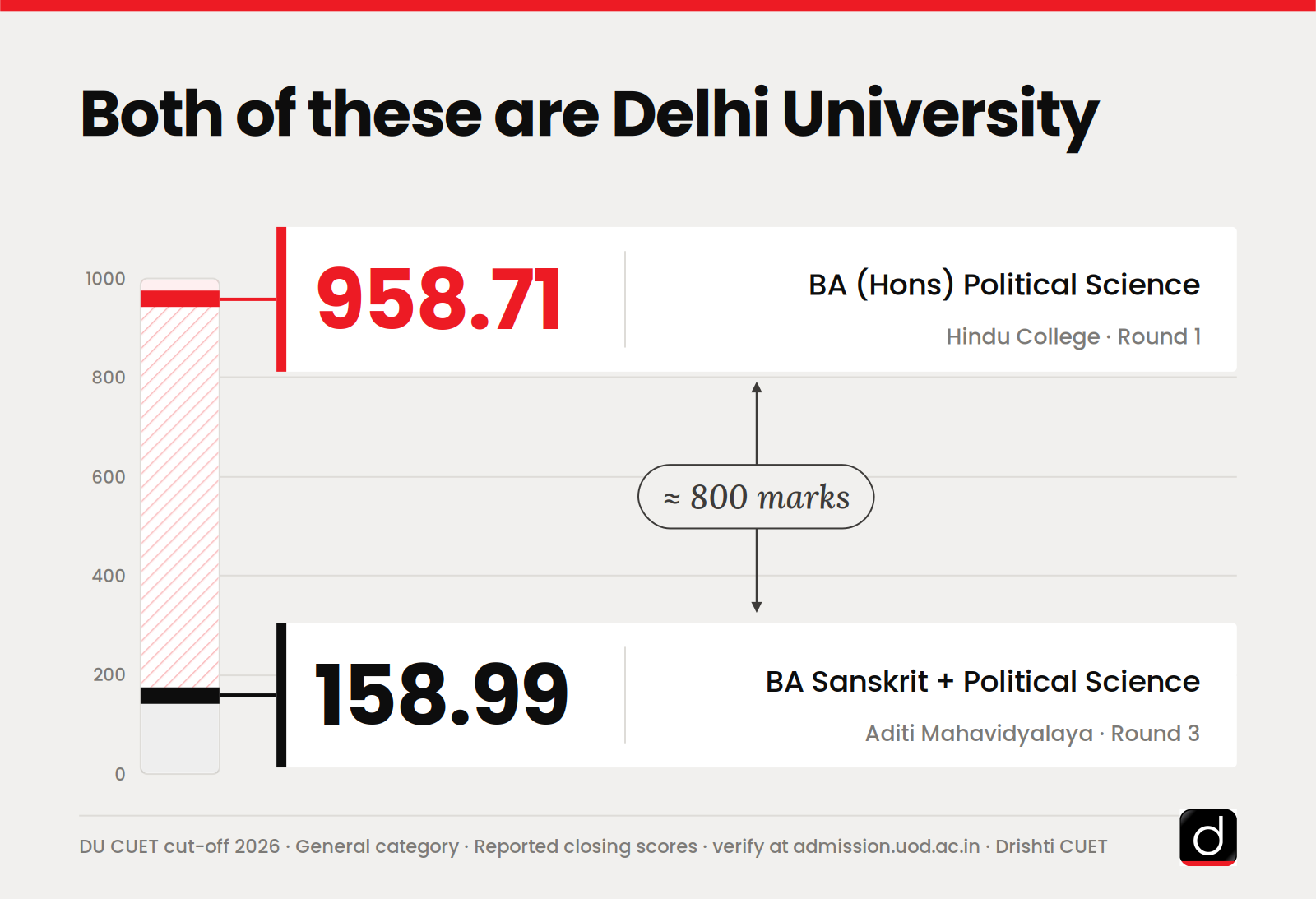
Delhi University's 2026 season finishes this week. It allotted seats across more than 71,000 places in 91 colleges, through three regular rounds, two upgradation rounds and a spot round. The DU CUET cut off 2026 figures across that season ranged from 958.71 at the top to under 160 at the bottom.
Both of those are DU. Same university, same degree, same convocation. Roughly 800 marks apart.
So before you set a target for CUET 2027, it is worth understanding what a cut-off actually is — because nearly every student misunderstands it in the same way, and that misunderstanding costs seats every single year.
How is the DU CUET cut-off decided? A cut-off is a receipt, not a target
This is the sentence to remember.
DU does not decide in advance that BCom (Hons) at SRCC requires 924. Nobody sets that figure. What happens is:
- Students fill and lock their programme-college preferences on the CSAS portal.
- DU allots seats in preference order, by normalised CUET score, within each category.
- Seats run out.
- The score of the last student who got a seat becomes the "cut-off".
That is the whole mechanism. The cut-off is generated afterwards, by that year's applicant behaviour. It is a receipt of what happened, not a threshold announced beforehand.
Three consequences follow, and they change everything:
- It reflects who applied, not how hard the course is. A programme can get harder to enter in a year when nothing about the programme changed.
- It moves every round, because each round has a different pool of remaining students and remaining seats.
- Last year's number is a zone, not a line.
Why your CUET score is different from your DU merit score
For most programmes DU builds merit from your best four subject scores out of 250 each, giving a maximum of 1000. That best-four-out-of-250 DU merit calculation is why the figure on your CSAS dashboard does not match the total on your NTA scorecard. Programme-specific criteria do vary, so check the Bulletin of Information for your course rather than assuming.
This confusion causes real panic every July. Students compare their five-subject total against a DU closing score, conclude they are 250 marks short, and walk away from a seat they had comfortably earned.
DU CSAS round-wise cut off 2026: what actually happened
Here is the part that most cut-off articles leave out. Watch the same course move across rounds.
|
Programme |
Round 1 Closing |
Round 2 Closing |
Round 3 Closing |
|
BA (Hons) Political Science |
958.71 (Hindu College) |
909.48 (Lady Shri Ram) |
— |
|
B.Com (Hons) |
924.30 (SRCC) |
910.29 (Lady Shri Ram) |
896.93 (Hansraj) |
|
BA (Hons) Psychology |
938.09 (Lady Shri Ram) |
936.03 (Lady Shri Ram) |
— |
|
BA (Hons) Sociology |
— |
— |
921 (Hindu College) |
|
B.Com |
— |
— |
878.50 (Ramjas) |
Highest reported closing score for that programme in each round.
Do DU cut-offs go down in later rounds?
Often, but not reliably — and the difference matters enormously.
Look at Political Science. Between Round 1 and Round 2, the top closing score fell by roughly 49 marks. That is not a rounding error. That is the gap between a year feeling wasted and getting the course you wanted. A student sitting at 912 who saw the Round 1 figure of 958.71, concluded "no chance", and stopped engaging with the process gave away a seat they had already earned.
Now look at Psychology in the same table. It moved about two marks across the same gap.
So the DU cut off round 1 vs round 3 comparison has no single answer. Some programmes collapse, some barely budge, depending entirely on how many students in that band ranked the programme highly and how many upgraded away. Since you cannot predict which pattern yours will follow, the only correct posture during counselling is to stay in the process until it is mathematically over.
What CUET score is needed for Hindu College BA Political Science?
Among reported 2026 figures, this was the toughest entry in the university: 958.71 in Round 1 for the General category — the highest CUET cut off at DU in 2026. If that is your target, understand that you are aiming at the absolute ceiling of the distribution, and build a preference list that does not depend on hitting it.
Which DU courses have the lowest CUET cut-off?
This is the fact that should genuinely change how you plan.
In Round 3 of 2026, the highest reported closing score at DU was 921 for BA (Hons) Sociology at Hindu College. The lowest reported closing score in the same round was 158.99, for a BA programme combination (Sanskrit and Political Science) at Aditi Mahavidyalaya. Same round, same university, roughly 760 marks apart.
And when DU released its Spot Round 1 vacancy list on 23 August, 13,433 UG seats were still open across 67 colleges.
Sit with that for a moment. Thousands of DU seats unfilled after five rounds of allocation — while lakhs of students believed DU was closed to them because they did not have 900.
That gap is not a scoring problem. It is an information problem. Students target roughly ten colleges and twelve courses, all of them clustered at the very top of the distribution, and then conclude that the university rejected them when in fact they never applied to most of it.
What score do I need for a DU off-campus college?
Considerably less than the campus headline figures, and the range is wide. Several off-campus programmes closed in the 400s in 2026, and some programme combinations closed far lower.
Off-campus does not mean second-rate. It is the same university and the same degree — and in 2026 it is where thousands of seats sat empty while students assumed they had nowhere left to go.
Why last year's CUET marks required for Delhi University are only a zone
Never treat a single past figure as your goal.
In 2026, a BA combination (Computer Applications and Political Science) at Bhagini Nivedita College closed at 445.74, down from 536.48 in 2025 — a fall of nearly 91 marks in one year. In the same season, a BA combination (Punjabi and Political Science) at Lakshmibai College rose by about 136 marks. Meanwhile at the top, BCom (Hons) at Hansraj closed at 896.93 in Round 3 against 899.60 the year before — a change of about three marks.
The pattern is consistent: the top of the distribution is stable, the middle and bottom are volatile. Popular programmes at famous colleges move by single digits. Everything else can swing 50 to 130 marks on applicant behaviour alone.
There is a second reason, and it is worth having the CUET normalised score explained plainly: because students sit different papers in different shifts, NTA normalises scores across shifts. A 900 in one year is therefore not arithmetically identical to a 900 in another. Treat any past cut-off as the centre of a band, never as a line.
Practical rule: take the closing score of your target programme, add a buffer of 30 to 40 marks, and make that your number. Then build a preference list that assumes the buffer might not hold.
CUET cut-off for science courses vs humanities: the asymmetry that should shape your subject choice
One more pattern with direct consequences for the 2027 batch.
The extreme closing scores at DU sit almost entirely in commerce and humanities — Political Science, Sociology, Psychology, Economics, BCom (Hons). Reported closing scores for several science programmes ran considerably lower, with some pure-science honours courses closing well below their humanities equivalents at comparable colleges.
Not because science is easier. Because of applicant volume and competing options. A strong science student is often also writing JEE, NEET or an institute-specific exam, so the CUET science pool is thinner. The commerce and humanities pool has fewer alternatives and concentrates almost entirely on CUET.
If you are planning your five CUET subjects for 2027, know this before you register in January, not after your result in June. It does not mean gaming the cut-off by switching streams — that is a bad reason to choose a degree you will live inside for three or four years. It means that if you are genuinely torn between two directions, the competitive landscape is not the same in both, and you deserve to know that while you can still act on it.
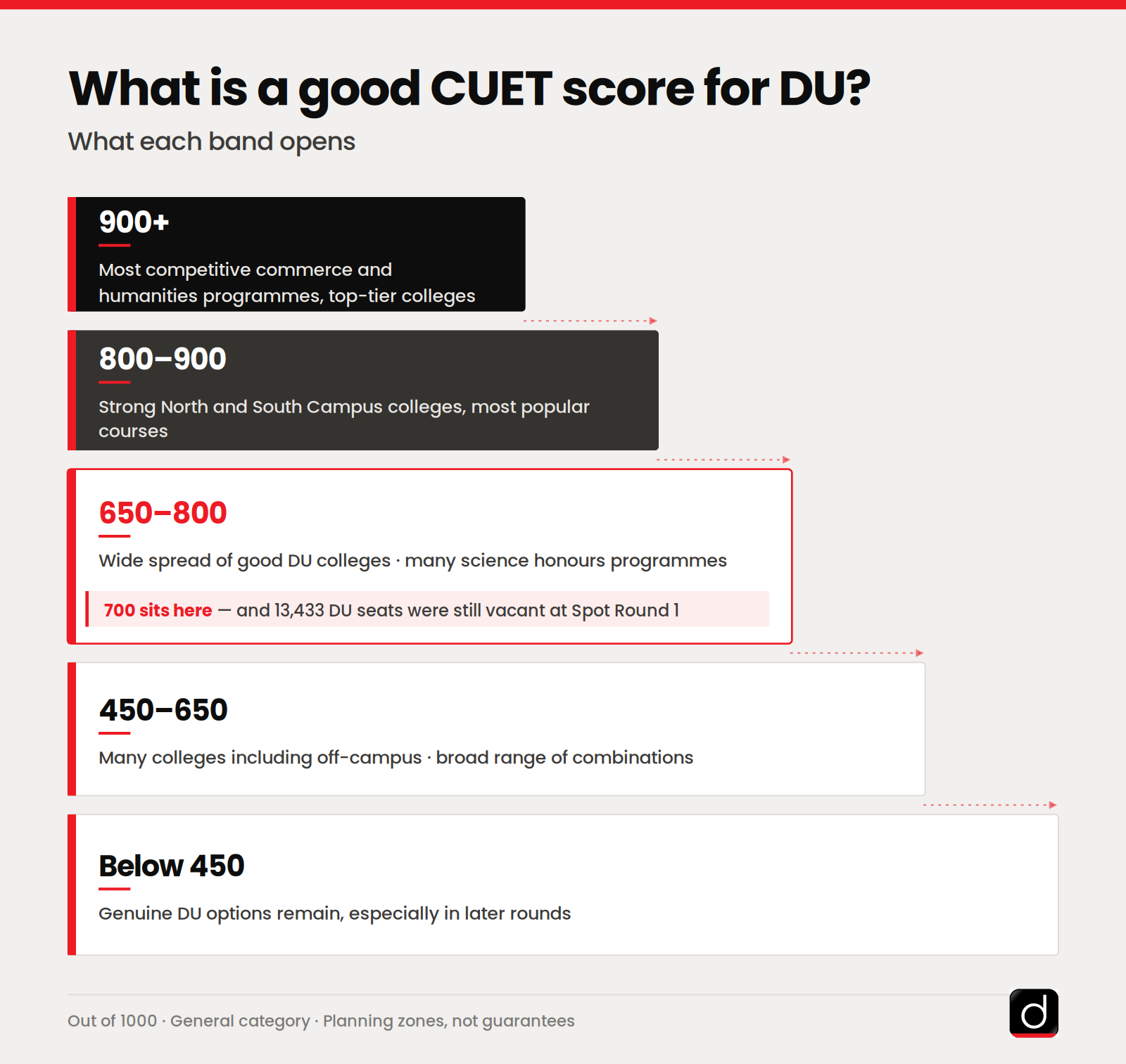
What is a good score in CUET UG? What each band realistically opens
Bands drawn from reported 2026 and recent-year closing scores. Zones for planning, not promises.
|
Normalised score (out of 1000, UR) |
What it realistically opens |
|
900+ |
The most competitive commerce and humanities programmes at top-tier colleges |
|
800–900 |
Strong North and South Campus colleges across most popular courses |
|
650–800 |
A wide spread of good DU colleges; many science honours programmes; strong BA combinations |
|
450–650 |
Many DU colleges including off-campus; a broad range of programme combinations |
|
Below 450 |
Genuine DU options remain, particularly in specific combinations and off-campus colleges, especially in later rounds |
Is 700 a good score in CUET UG? For DU, yes — with an important qualifier. At 700 you are outside the top-tier commerce and humanities programmes, but inside a genuinely wide band of good colleges and many science honours courses. Whether 700 converts into a seat depends far more on the breadth of your preference list than on the score itself. Students at 700 with 150 well-ordered preferences do considerably better than students at 760 with twenty.
Reserved-category closing scores run lower than UR across almost every programme, so read your own category's column rather than the headline.
Five ways students misuse DU cut off 2026 CUET data
1. Targeting the Round 1 figure and quitting. Round 1 is the hardest round of the year. Judging your chances by it, then disengaging, is the most common self-inflicted loss in the entire CSAS process.
2. Filling a short preference list. If a programme-college combination is not on your locked list, you are not considered for it, whatever your score. Cut-off data should widen your list, not shorten it.
3. Confusing total marks with merit score. See the best-four calculation above.
4. Reading UR figures when you are in a reserved category, or the reverse. Materially different numbers. This error has made students both aim too low and quit too early.
5. Ignoring subject mapping. A high score does not create eligibility. If your CUET subjects or Class 12 subjects do not satisfy a programme's requirements, the cut-off is irrelevant to you. Check subject mapping before choosing your five CUET subjects in January — this is the one CUET mistake that cannot be fixed later.
What this means for your September
If you are in Class 12 now, here is how to convert all of the above into something usable in the next four weeks.
Step 1 — Build the sheet before the timetable. Ten to fifteen rows: target programme, target college, required Class 12 subjects, required CUET subjects, 2026 closing score for your category. This one document decides your subject choices, your target and your preference strategy.
Step 2 — Set a buffered target. Highest relevant closing score, plus 30 to 40 marks. Write it down. That is your number for the year.
Step 3 — Convert it into a per-subject target. A target of 800 across four counted subjects is roughly 200 out of 250 per subject — about 80%. Far more usable than "I need 800".
Step 4 — Give your weakest counted subject the most time. DU counts your best four, so one weak paper drags your merit down more than one strong paper lifts it.
Step 5 — Plan around your school calendar, not against it. Half-yearlies, pre-boards and boards are fixed points. The students who struggle are almost never the ones who lacked ability — they are the ones who ran board preparation and CUET preparation as two separate, competing projects until February, and then had to abandon one.
This is the specific problem our FUSION Batch was built for: Class 12 students who need board syllabus and CUET preparation running as one integrated plan rather than two. Because the CUET syllabus draws on the Class 12 NCERT curriculum, the overlap is real and it can be used deliberately — most students simply never map it, and end up doing the same chapter twice in two different ways.
If you are preparing for CUET 2027 again
If you appeared in 2026 and are targeting CUET 2027, cut-off data is more useful to you than to anyone else — because you now have your own scorecard to measure against it.
Do this before you open a single textbook: put your 2026 subject-wise scores next to the closing scores of your target programmes, and identify exactly where the gap sat. Was it one weak counted subject? The General Aptitude Test? Or was your score actually fine and your preference list too narrow? Those three diagnoses need completely different responses, and a year of undirected preparation will fix only one of them.
Structure is the other half of it. School gave you a timetable, attendance and visible peer progress. A preparation year removes all three at once, and the students who plateau are usually the ones who never replaced them. Our CAMPUS Batch is designed around exactly this — a full-cycle CUET 2027 preparation track for droppers and repeat aspirants, with the schedule, testing and mentoring structure that a self-directed year does not supply on its own.
Whichever route you take, decide on your structure in the next four weeks. September decisions are worth far more than January ones.
On the 2027 schedule
NTA has not yet released the official CUET UG 2027 information bulletin. Reports suggest a 2027 exam calendar covering CUET, JEE Main and NEET UG may be published around September 2026. Until it exists, treat every 2027 date circulating online as an estimate.
For complete information on CUET 2027 — expected exam dates, registration timeline, eligibility criteria and syllabus — read our detailed guide: CUET UG 2027: Exam Date, Registration, Eligibility & Syllabus.
A note for parents
If your child has told you they need 900 for Delhi University, they are quoting a real number about a small slice of the university.
The more useful conversation is narrower and calmer: which specific programmes, at which specific colleges, and what did those actually close at last year for our category? That is an hour with a spreadsheet, and it replaces a year of vague anxiety with a concrete target.
It also protects your child from both failure modes. A student who believes only 900 counts either burns out chasing it or never properly starts. A student who knows their real target is 780 and their buffered target is 815 has something they can actually work towards on a Tuesday in November.
How we read cut-offs at Drishti School
Three things, in this order, and we would suggest you do the same.
The range, not the headline. The highest closing score in a university tells you almost nothing about your chances. The distribution tells you everything.
The round-wise movement. A programme that fell 49 marks between rounds behaves nothing like one that fell two. Knowing which is which decides whether you keep upgrading or lock in early.
Eligibility, before score. We have watched capable students lose courses to subject mapping they never checked. No amount of preparation fixes an eligibility mismatch discovered in July.
If you want a second opinion on your own target list before your half-yearlies, that is a genuinely useful hour to spend — with a school counsellor, a teacher who knows your work, or with us. You can see how our CUET 2027 batches are structured for the two situations students are usually in: FUSION for Class 12 students running boards and CUET together, CAMPUS for droppers preparing full-time.
What we would advise against is setting your target for the year off a number someone quoted in a reel.
Frequently Asked Questions
1. What is a good CUET score for DU?
It depends entirely on the programme and college. For the most competitive commerce and humanities courses at top DU colleges, reported 2026 closing scores ran above 900 out of 1000 for the General category. Strong campus colleges across most popular courses sat roughly in the 800–900 band, a wide spread of good colleges in the 650–800 band, and genuine DU options existed well below 450, particularly in specific programme combinations and off-campus colleges. Reserved-category closing scores were lower across almost every programme.
2. How is the DU CUET cut-off decided?
It is not decided in advance. DU allots seats by normalised CUET score within each category, following students' locked preferences. When the seats for a programme run out, the score of the last student allotted a seat becomes that round's cut-off. It is a record of what happened, not a threshold announced beforehand.
3. Do DU cut-offs drop in later rounds?
Often, but not always, and not uniformly. In 2026 the top closing score for BA (Hons) Political Science fell by roughly 49 marks between Round 1 and Round 2, while BA (Hons) Psychology moved by only about two marks over the same gap. Because you cannot predict which pattern your programme will follow, stay active in the process until it formally ends.
4. What was the highest DU cut-off in 2026?
Among reported figures, BA (Hons) Political Science at Hindu College closed at 958.71 in Round 1 for the General category. Verify against DU's official allocation lists.
5. Can I get into DU with 600 marks in CUET?
Yes, for a range of programmes and colleges — but not for the most competitive commerce and humanities courses at top-tier colleges. In 2026 several reported Round 3 closing scores fell well below 450, and DU still had 13,433 seats vacant across 67 colleges going into Spot Round 1. Your chances depend far more on the breadth of your preference list than on the score alone.
6. Why is my DU merit score different from my CUET total?
For most programmes DU builds merit from your best four CUET subject scores, each out of 250, giving a maximum of 1000 — not your full five-subject total. Programme-specific criteria vary, so check the Bulletin of Information for your course.
7. Are DU cut-offs lower for science courses than for humanities?
In recent years, reported closing scores for several science honours programmes have run considerably lower than for top commerce and humanities programmes. The likeliest reason is applicant volume: strong science students often also write JEE, NEET or other exams, so the CUET science pool is thinner. This should inform your subject planning, but it is a poor reason on its own to choose a degree.
8. Do Class 12 marks affect the DU cut-off?
No. DU allots UG seats through CSAS on normalised CUET scores; Class 12 marks establish eligibility, including any required subjects. Separate routes such as NCWEB and SOL are Class-12-merit based, as are the specific colleges DU permitted to admit on Class 12 merit for 2026-27.
9. How many seats does DU have for CUET admission?
More than 71,000 UG seats across 91 colleges were allocated round-wise on the basis of CUET UG 2026 scores.
10. Should I use last year's cut-off as my target for CUET 2027?
Use it as the centre of a band, not a line. Top-tier programmes tend to move only a few marks year on year, but mid-range programmes swung by 90 to 135 marks between 2025 and 2026. Normalisation also means a score in one year is not arithmetically identical to the same score in another. Add a 30–40 mark buffer to the relevant closing score and target that.
11. When is CUET 2027 and when does registration open?
NTA has not yet released the official CUET UG 2027 information bulletin, so all circulating dates are estimates. In recent cycles the exam has been held around May–June with registration opening early in the year. For the full expected timeline, eligibility criteria and syllabus, see our CUET UG 2027 guide.
12. Should droppers and Class 12 students prepare for CUET differently?
Yes, substantially. A Class 12 student's core problem is integration — running board preparation and CUET preparation as one plan instead of two competing ones, which is what our FUSION Batch addresses. A dropper's core problem is diagnosis and structure — identifying exactly where last year's score fell short, then replacing the timetable, testing and accountability that school used to provide, which is what the CAMPUS Batch is built around. You can compare both at drishtilearningapp.com/cuet/courses.