- College Predictor 2026
- About CUET (UG)
- Courses
- Blogs
- Home
- Logout
- Login
- Language: Eng | हिंदी
DU CSAS Phase 3 2026: Seat Acceptance, Document Verification, Freeze/Upgrade & Fee Payment -Complete Guide
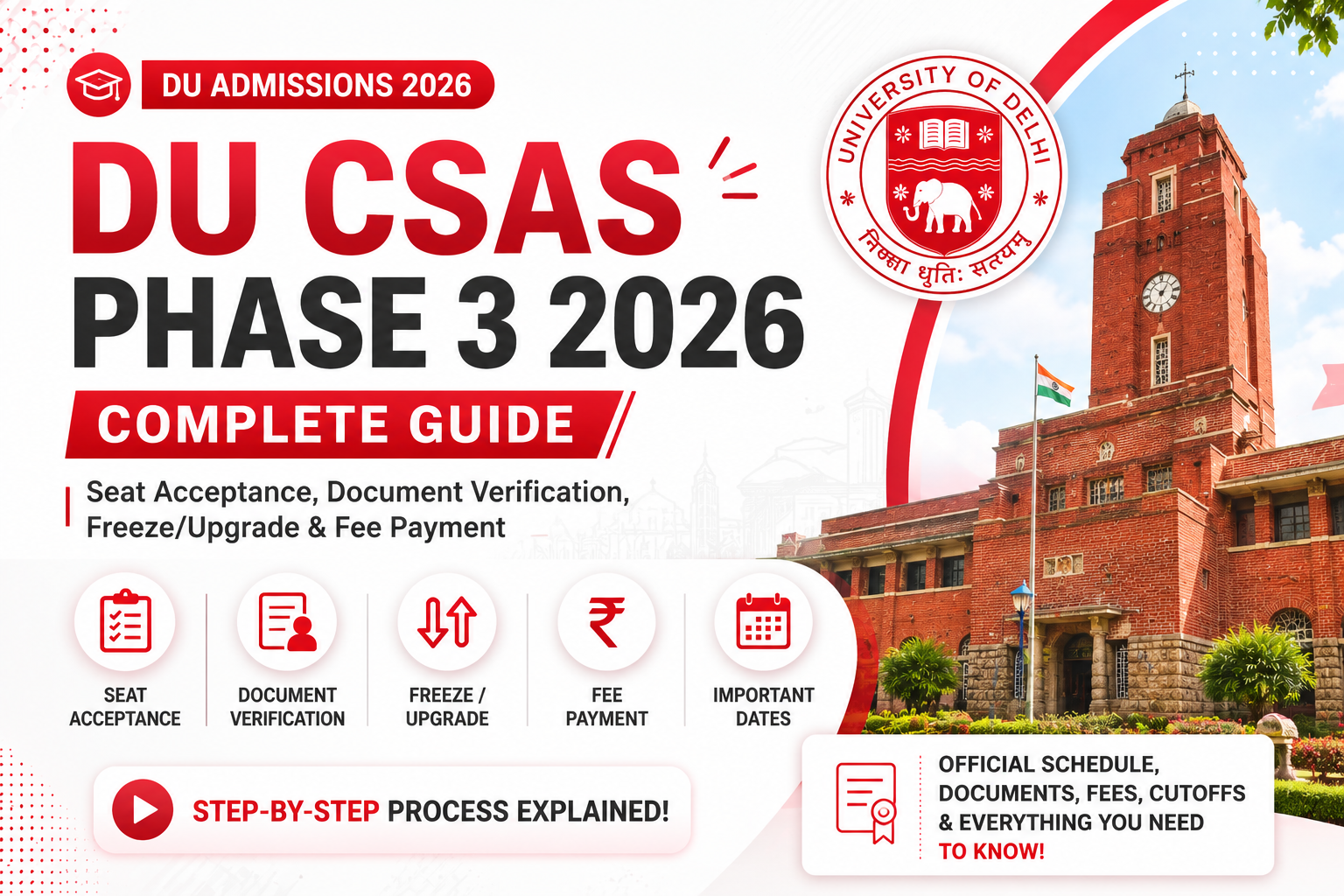
Delhi University's admission process under the Common Seat Allocation System (CSAS-UG) moves into its most crucial stage once the seat allocation list is out, CSAS Phase 3, also known as the Allocation-cum-Admission phase. This is where candidates accept their allotted seat, go through document verification, pay the admission fee, and finally decide whether to freeze their seat or try for an upgrade.
This guide breaks down the entire DU CSAS Phase 3 2026 process step-by-step, along with the official schedule and a video walkthrough to help you avoid common mistakes.
Watch: DU CSAS Phase 3 2026 Step-by-Step Video Guide
For a complete visual walkthrough of the Phase 3 process, watch our detailed video below:
Video: DU CSAS Phase 3 2026 LIVE | Delhi University Form Filling Step-by-Step | Complete Process
What Is DU CSAS Phase 3?
CSAS admission at Delhi University is completed in three phases- Phase 1 (Registration), Phase 2 (Programme & College Preference Filling), and Phase 3 (Allocation-cum-Admission). Phase 3 is where CUET UG scores, category, and preference order come together to generate the seat allocation list, after which candidates must act quickly within fixed windows to confirm their admission.
DU CSAS Phase 3 2026: Schedule & Important Dates
Here is the official timeline for the Phase 3 process as per DU's published notification:
|
Event |
Date |
|
First CSAS seat allocation list (Round 1) |
July 16, 2026 (5 PM) |
|
Seat acceptance window (Round 1) |
July 16 to July 18, 2026 |
|
College-level document verification |
July 16 to July 20, 2026 |
|
Last date for admission fee payment (Round 1) |
July 21, 2026 (5 PM) |
|
Freeze / Upgrade option becomes available |
After fee payment & final verification |
|
Second CSAS allocation list (Round 2) |
July 25, 2026 (12 Noon) |
Please note: Only the first allocation date (July 16) has remained fixed across DU's notifications so far. The remaining dates, seat acceptance, verification, and fee payment windows are sometimes revised by the university after the initial schedule is published. Always cross-check these against the latest notice on the official CSAS portal before acting on a deadline.
Official Notification Link: admission.uod.ac.in
Step-by-Step Guide: What to Do in DU CSAS Phase 3
Step 1: Check Your Seat Allocation Result
Log in to admission.uod.ac.in with your CUET UG 2026 credentials and check your dashboard for the allotted programme and college.
Step 2: Accept the Allotted Seat
Within the seat acceptance window, click 'Accept' on your dashboard to confirm you want to proceed with the allotted seat. If you see a server error, wait and retry- this is usually due to heavy traffic during peak hours and does not affect your admission.
Step 3: Complete Document Verification
Your documents are verified by the allotted college through multiple approval stages before the fee payment option becomes active on your dashboard. The exact stages and turnaround time can vary from college to college, so processing time will naturally differ across colleges and courses -don't be alarmed if your verification takes longer than a friend's at a different college.
Step 4: Pay the Admission Fee
Once verification is complete at all three levels, the fee payment link becomes active on your dashboard. Pay the fee before the deadline, missing it can lead to forfeiture of your allotted seat.
Step 5: Choose Freeze or Upgrade
After successful fee payment, you'll be asked to choose between two options:
- Freeze: Lock in your current seat with no further changes.
- Upgrade: Keep your current seat while remaining in the running for a higher preference in the next round. If you do get upgraded, you cannot revert to your earlier seat, so choose carefully.
Common Issues Students Face in Phase 3 (And How to Handle Them)
- Fee payment link not visible: This almost always means document verification is still in progress at the college's end, wait for it to complete rather than assuming a technical fault.
- Errors while accepting a seat: Usually server load during high-traffic hours; retry within your acceptance window.
- Confusion between Freeze and Upgrade: Remember that upgrading means giving up your current seat permanently if a higher preference comes through.
- Losing track of deadlines: Keep checking your CSAS dashboard and registered email regularly, as DU does not send reminders via SMS.
Documents Required for DU CSAS Phase 3 Verification
Keep both scanned copies (already uploaded during registration) and original hard copies ready, since colleges verify documents in original before confirming admission. Exact requirements can vary slightly by college, but commonly required documents include:
- Class 10 marksheet/certificate (for date of birth and name verification)
- Class 12 marksheet with subjects and marks clearly visible
- Class 12 passing certificate / provisional certificate
- CUET UG 2026 scorecard / rank confirmation page
- Category certificate (SC/ST/OBC-NCL/EWS/PwBD, etc.), if applicable, issued by a competent authority
- Migration certificate, may be required depending on the allotted college (a signed undertaking can be used if not yet issued by your board)
- Recent passport-size photograph and signature (as uploaded during CSAS registration)
- Character certificate from the last attended institution, may be required depending on the allotted college
- Aadhaar card or another valid government photo ID
- Anti-Ragging undertaking (usually generated and signed online during admission confirmation)
Note: If your migration certificate or final marksheet isn't available yet, DU allows you to download an undertaking format from the admission portal, fill it out, sign it, and upload it in place of the original document until it is issued.
Important: Names on your category, migration, and academic certificates must match exactly with your school board certificates and your CUET UG 2026 application form, including your parents' names. Mismatches are a common reason for verification delays or rejection.
Eligibility Recap Before You Proceed to Phase 3
Before your Phase 3 admission is finalised, it's worth reconfirming that you meet DU's baseline eligibility conditions, since document verification checks these directly:
- Must have appeared in and qualified CUET UG 2026, conducted by NTA
- Must have passed Class 10+2 or an equivalent examination from a recognised board
- Must have appeared in CUET papers matching the Class 12 subjects required for the allotted programme (subject mapping)
- Category, EWS, PwBD, or ECA/Sports quota certificates must be issued by a competent authority and match the candidate's other documents
Important: Minimum qualifying percentage, subject combinations, and other eligibility conditions differ by programme, for instance, B.Com (Hons), BA (Hons) Economics, and various BSc programmes each carry their own requirements. Rather than relying on a single generic percentage, candidates must satisfy the programme-specific eligibility criteria prescribed in the official DU UG Bulletin of Information 2026-27, available on admission.uod.ac.in.
DU CSAS Registration Fee Structure (For Reference)
While Phase 3 itself involves the college-specific admission fee (which varies by programme and college), it helps to know the CSAS registration fee structure paid earlier in Phase 1, since refund and payment queries often reference it:
- General, OBC-NCL, and EWS category: ₹250
- SC, ST, and PwBD category: ₹100
- Additional charge for BFA programmes: ₹400 extra
- Additional charge for Sports/ECA quota applicants: ₹100 extra
This CSAS registration fee is separate from, and non-refundable unlike, the college admission fee you pay during Phase 3 to confirm your seat.
DU UG 2026: Seats, Colleges & Competition Snapshot
- Total seats available: More than 70,000 UG seats across DU for the 2026-27 session
- Total participating colleges: All 91 constituent colleges of Delhi University
- Total programmes: 73 undergraduate programmes plus 150 BA Programme subject combinations
- Phase 1 & 2 registration volume: DU recorded 1,90,645 candidate registrations and 1,64,098 completed preference submissions by the July 11, 2026 deadline
- 2025 cutoff trend for reference: In Round 1 of 2025, some of the most competitive General-category programmes, such as English (Hons) at St. Stephen's and Political Science (Hons) at Hindu College, recorded cutoffs above 925 out of 1,000, with cutoffs for most programmes typically easing over subsequent rounds
Cutoffs vary significantly by programme, college, and category, so treat the figures above as an illustrative reference rather than a prediction for 2026. Always check the official college-wise, category-wise cutoff data published on the CSAS portal after each allocation round.
Since DU allocates seats purely on CUET UG score, category, and preference order, with no weightage to board marks, candidates with lower scores on a high-demand programme sometimes get a realistic shot only in later rounds, which is where the Upgrade option becomes relevant.
Frequently Asked Questions (FAQs)
Q1. What is DU CSAS Phase 3?
DU CSAS Phase 3, also called the Allocation-cum-Admission phase, is the final stage of Delhi University's UG admission process. It covers seat allocation, seat acceptance, document verification, fee payment, and the freeze/upgrade decision.
Q2. When does the freeze or upgrade option appear on the CSAS portal?
The freeze/upgrade option becomes visible only after your seat acceptance is confirmed, your documents are verified by the allotted college through its internal approval stages, and you have successfully paid the admission fee.
Q3. What is the difference between Freeze and Upgrade in DU CSAS?
Freeze means you accept and lock your currently allotted seat with no further changes. Upgrade means you keep your current seat while remaining eligible for a higher preference in the next allocation round, but if you get upgraded, you cannot go back to your earlier seat.
Q4. What should I do if the fee payment link is not showing on my dashboard?
This usually means your document verification is still in progress at the allotted college's end. Since verification volumes are high, processing times vary by college and course, so continue checking your dashboard rather than assuming an error.
Q5. What if I get an error while accepting my seat?
Errors such as a failed request are typically due to high server traffic during peak hours. Wait and retry within the seat acceptance window rather than assuming your admission is affected.
Q6. Is the CSAS admission fee refundable if I upgrade or withdraw later?
The CSAS registration fee paid in Phase 1 is non-refundable. Refund and withdrawal rules for the college admission fee paid in Phase 3 are governed by DU's official refund policy for the given academic session, so candidates should read the refund clause on the portal before paying.
Q7. How many colleges and seats does DU CSAS UG 2026 cover?
CSAS UG 2026 covers all 91 constituent colleges of Delhi University, with more than 70,000 undergraduate seats available across 73 programmes and 150 BA Programme combinations.
Q8. Where can I check the official DU CSAS Phase 3 schedule?
The official and most updated schedule is available at admission.uod.ac.in.
Stay Updated with Drishti CUET
DU CSAS Phase 3 is a fast-moving, deadline-driven stage, missing even one step can cost you your seat. Keep this guide handy, watch the video walkthrough above, and check back with Drishti CUET for real-time updates through every round of DU admissions 2026.
Official Reference Links
- Delhi University CSAS UG Portal: https://admission.uod.ac.in/
- CUET UG 2026 (NTA): https://exams.nta.nic.in/
Disclaimer: Dates mentioned in this article are based on official notifications available at the time of publishing. Candidates are advised to cross-check the latest updates on the official DU admission portal, as schedules are subject to revision by the university.